
Park Slope's Lesbian Herstory, Alive and Well in the Archives

R.A.E. Wells is a writer from London now based in Brooklyn. She takes photos of her neighborhood on Instagram @parkslopepictures.
When I first moved to New York, I couldn’t wait to live at the epicenter of gay history, picturing the iconic Manhattan sites of the Stonewall Inn and Christopher Street Piers. What I didn’t know was that by moving into an apartment in South Slope, I would be living steps from one of the largest and oldest collections about, by, and for lesbians in the entire world.
At first glance, the Lesbian Herstory Archives, located in a 1908 limestone townhouse on 14th street, looks like any other Park Slope family home, its identity only denoted by a small rainbow flag on its door and lesbian-flag-colored pots of lavender perched outside.


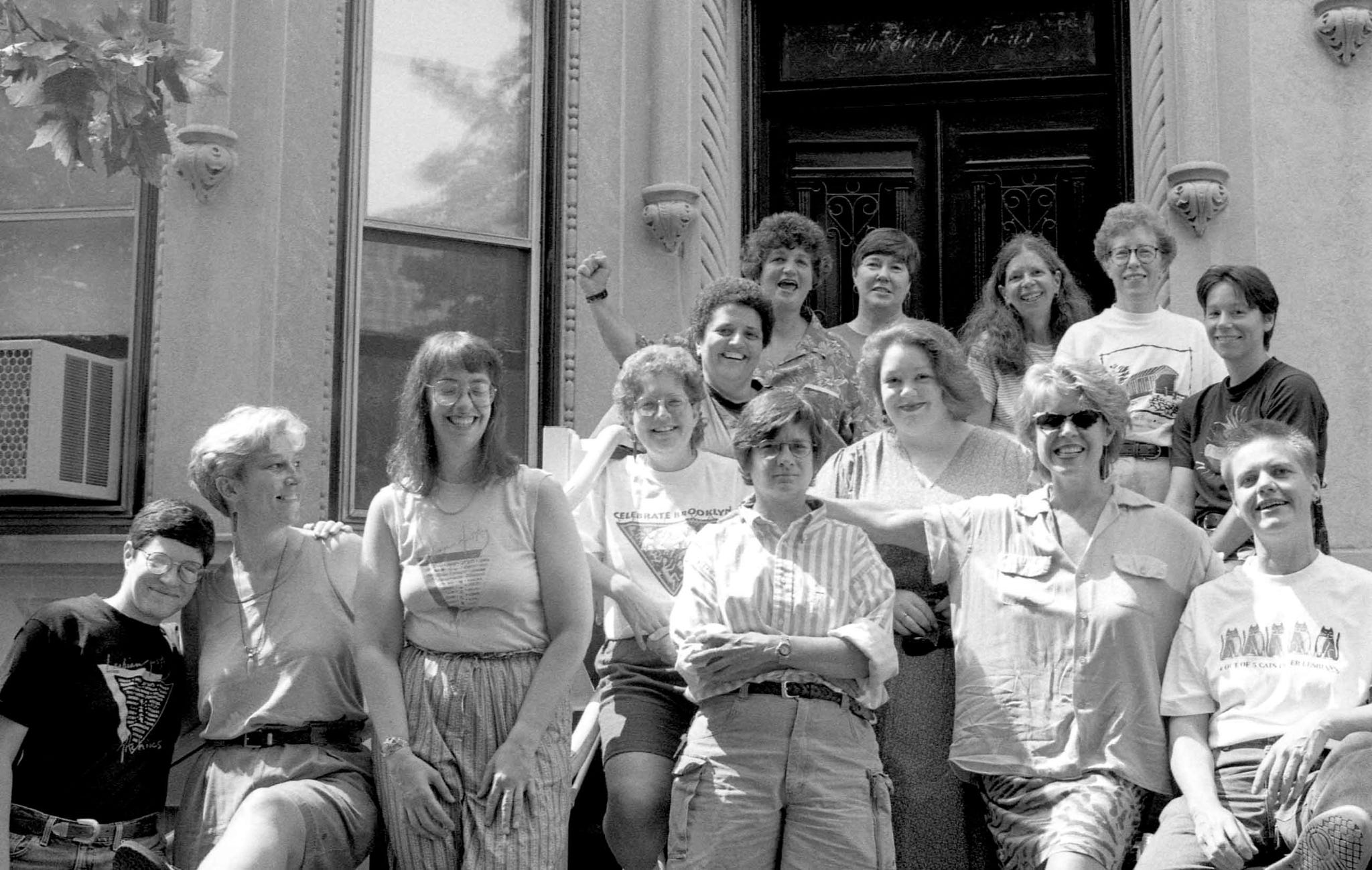
Park Slope became known by the moniker “Dyke Slope” during the area’s early waves of gentrification in the 1980s, when lesbians flocked from Manhattan to the more affordable, Hispanic-populated Brooklyn neighborhood. The Lesbian Herstory Archives officially opened its doors here in 1993. Its newsletter noted that “a large concentration of NY dykes live within walking distance” of its new home.
I stepped into the Archives’ townhouse for the first time this Pride Month. It felt like visiting the home of your lesbian great-aunt who has a hoarding problem — fetchingly chaotic and exceedingly cool.
The Archives were originally founded by members of the Gay Academic Union in the 1970s, out of the urgent sense that, as co-founder Deborah Edel put it, “Our history was disappearing as quickly as we were making it.” Initially operating out of the Upper West Side home of the legendary Jewish writer Joan Nestle, its growing materials soon demanded a larger space.
The collections’ permanent home in Park Slope was purchased for $163,000 after years of community fundraising drives; it was, and still is, run entirely by volunteers, who “painted and plastered” the building by hand. The name Lesbian Herstory Archives was both intentionally serious in its stipulation of preserving lesbian history specifically, rather than chronicling broader feminist or queer experiences, but also tongue-in-cheek, with Deborah Edel describing the use of “Herstory” over History as a choice “to prove we had a sense of humor”.
I stepped into the Archives’ townhouse for the first time this Pride Month. It felt like visiting the home of your lesbian great-aunt who has a hoarding problem — fetchingly chaotic and exceedingly cool. Piles of boxes are stacked high and haphazardly around its parlor fireplace; volunteers of all ages giggle and kvetch around a large dining table; to get to the gender neutral bathroom, you walk past iconic lesbian leather and denim jackets hanging in the hallway.
There are regular and free open hours for visitors, with no institutional affiliation needed. Some visitors are academics or authors who use the collections for research, whereas others are simply interested community members, hailing from near and far (a recent Google review reads: “The archive wasn’t open to the public on the day I visited but the lovely volunteers took pity on me being from Australia and let me in anyway”.)
"The word archives can conjure up images of dusty historical relics, sitting staid and preserved. But the team running it are “more interested in thinking about ways this can be a living archive in a living space”.
The Archives has an expansive definition of what constitutes lesbian history, welcoming everything from personal journals to slogan buttons to erotic periodicals. Visitors are invited to rifle through the materials by hand unsupervised, simply told to use “lesbian outcards” to ensure they return materials to their correct spot.


The site departs from institutional archival traditions in its filing systems. Historian and former Archives coordinator Rachel Corbman explains that “the decision to file material alphabetically by first name” challenges the convention of identifying women by male-inherited surnames, while also protecting the privacy of lesbians who only wanted to be known by their first name. Rachel also notes the “pivotal” decision in 1979 to create “special collections”, which keep materials donated by individuals or organizations grouped together. The Archives’ success lies in its ongoing power to keep lesbian history alive; it is fitting that they organize these collections by the person who donated them, rather than slicing up a life’s items into subsections of genre or form.
The Lesbian Herstory Archives are beloved by many in the community. Jack Jen Gieseking, author of A Queer New York, describes it as “a constant, bright star… a set of rooms of one’s own that all dykes are welcome to share”. The site is not reserved exclusively for research, but also hosts film screenings, group Wikipedia edit-a-thon sessions, and an annual Dyke Prom. The volunteer-team are also continuing to digitize materials to expand their reach, from thousands of oral herstory cassettes to a searchable online t-shirt catalog.
And the influence of the Archives’ politics extends beyond the confines of its space. This April, Mayor Zohran Mamdani appointed former Archives’ coordinator Shawn(ta) Smith-Cruz as “chief keeper of the city’s records”; Shawn(ta)’s approach to preserving New York City’s history and responding to ongoing public information requests will no doubt be informed by her twenty-year tenure at the Archives.


The word archives can conjure up images of dusty historical relics, sitting staid and preserved. Special Collections Coordinator Olivia Newsome told me that the team running it are “more interested in thinking about ways this can be a living archive in a living space”, where collections are “activated” for today. Olivia feels a sense of relief when transferring personal papers from lesbian elders into the collections; she recently worked with Dr. Wilhelmina Perry to do so, an LGBTQ interfaith community leader now in her nineties. As Olivia put it, archiving the history of lesbians like Dr. Perry shows that “we will always be faced with something, and we’ve always survived it.”
Whether Dyke Slope is a historical or current phenomenon depends on who you ask. Jack Jen Gieseking’s queer history of New York argues that the “markers” of lesbian communities who moved to Park Slope, bringing co-ops, feminist bookstores, and yoga studios, ironically created the attractive cultural conditions that priced out some of its residents: “Where lesbian clogs, boots, and heels tread, price hikes soon followed.” The Archives, too, is somewhat victim to its own success; its three-floor home can no longer fit the majority of its collections on-site.
In a newsletter announcing the Archives’ move to Park Slope over thirty-years ago, co-founder Joan Nestle described the experience of living amongst its holdings: “I have heard voices thick with desire, voices cracked by time or social sanctions, but in my home, the home of the Lesbian Herstory Archives, they all spoke, all at once, the past and the present, the old and the new.” As long as the Archives are in Park Slope, our neighborhood will always be a distinctive home for the lesbian community; all of us are lucky to share in its past and its present, too.


You can support the Lesbian Herstory Archives by attending their upcoming Brooklyn Pride Book Sale on Saturday June 13th on Fifth Ave. You can also donate money and shop their merchandise here.
 |
|
“It felt like visiting the home of your lesbian great-aunt who has a hoarding problem — fetchingly chaotic and exceedingly cool.” This might be my new favorite line of writing.
I had no idea you could visit! Thanks for teaching me something new, always.