
The Analog Stationer's Case for Pen and Paper
Chaya Cohen Tamir's tiny Prospect Heights stationery shop proves that the pen and paper did not just survive the digital age — they solve something it cannot.
Nick Papa is a third-generation Brookylnite who lives in Gowanus. Follow Nick on Substack for more.
In a postage-stamp-sized shop in Prospect Heights, Chaya Cohen Tamir is helping me select a pen. I hand her my Bic Clic, one of many I have collected from restaurants. This one, branded by an Italian cafe in East Hampton, makes me think of a cooling shakerato. It is, by design, an advertisement — not a serious writing tool.
I pull up a stool at The Analog Stationer, which carries pens of every size, shape, and color. Chaya offers me options, and I test each one.
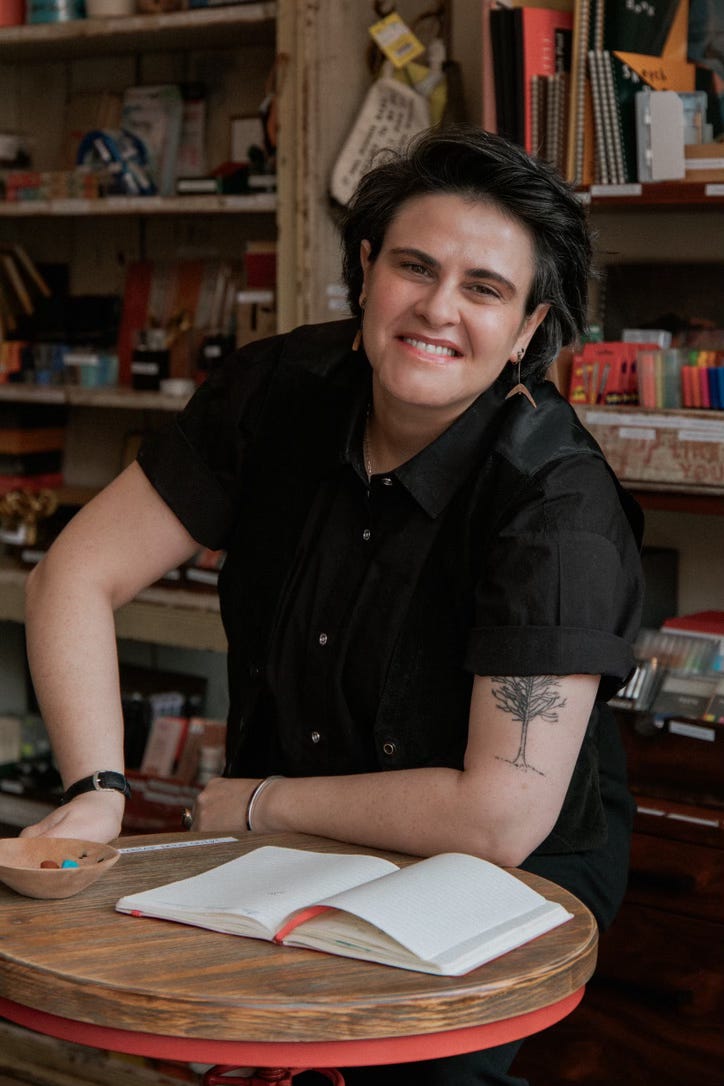
“Too scratchy?” She hands me another. “Ink too thick? Try this one.”
The Uniball Zento is a smooth writer, and has a wider barrel than my Bic Clic — making it much easier to grip. For the modest price of $4, I go home with a proper pen.
It is a small but unusual transaction.
Over the last 50 years, we have accepted digital transformation as inevitable. We left behind typewriters for word processors, and film cameras for smartphones. At each step, the new technology seemed faster, cheaper, and more capable than what it replaced.
And yet the pen and paper are still here. More people choose and prefer them than the narrative of progress suggests. The question worth asking is not whether analog survives — it does — but how?
After a career as an adjunct professor at Touro College, Chaya’s love of stationery became its own question. Was she drawn to school, or the school supplies? Opening The Analog Stationer in early 2025 was, in part, a way to find out.
Forbes broke the so-called stationerycore trend a few months later. “Often seen as a practical necessity,” they reported, “writing instruments, notebooks, and planners are now coveted lifestyle objects.”
The trend coverage, inevitable as it was, obscures the more interesting fact. The pen and paper are not seeing a resurgence — they never actually went away. Through wave after wave of digital innovation — word processors, tablets, productivity apps — no alternative made them obsolete.
“The page contains writing,” Chaya says. People choose it as a method for concentrating attention and thought — a way of keeping the mind in one place.
She appreciates the quality of thinking that writing by hand produces. “It makes you feel alive,” she says. “It triggers thought patterns in ways that digital tools do not.”
Digital tools, by contrast, become “this never-ending, always editable, always perfectible bit. You are always optimizing and trying to make it better.” The pen does not allow that. It compels the writer to make choices and move forward, letter by letter, word by word.
That same instinct — that limits can be a gift — shapes the shop itself. With only 170 square feet, Chaya stocks her shelves to appeal to essayists and calligraphy hobbyists alike.
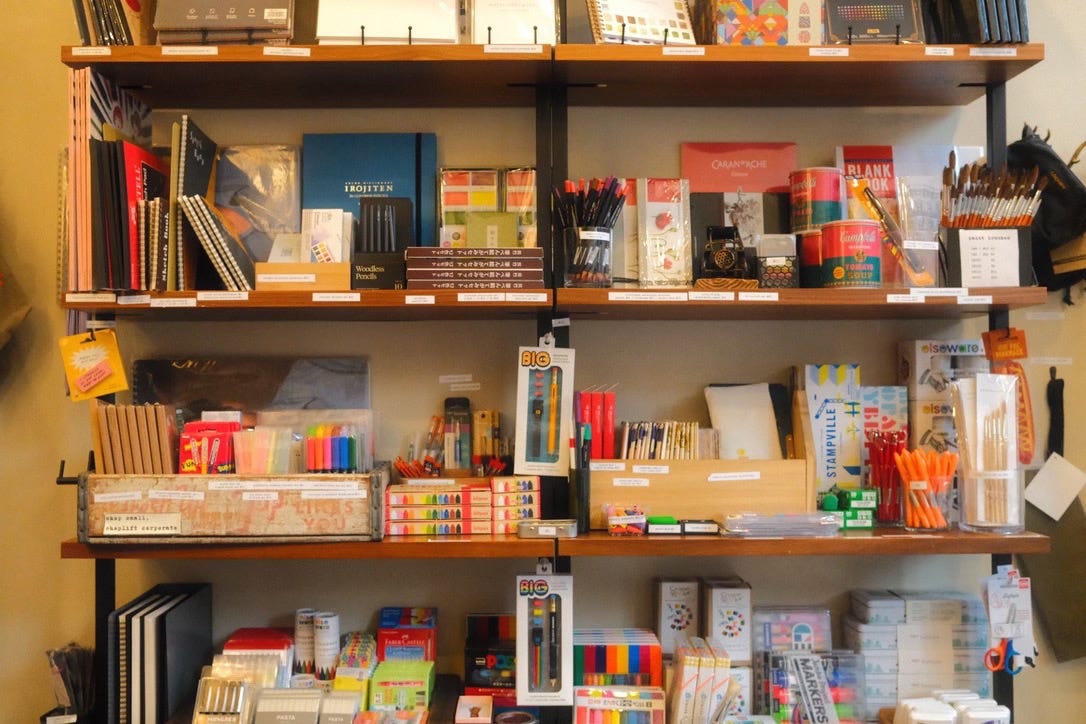
Expensive Kakimori alumnium fountain pens and Brut Homeware scissors — the latter in a fancy buffalo leather sleeve — sit alongside the affordable everyday. She recommends the Yu-Sari notebooks from Nakabayashi and Anterique mini ballpoint pens that come in more than ten colors.
Chaya rejects the idea that aesthetics or nostalgia are driving any of this.
“For Gen Z, this is not about nostalgia,” she says. “These are kids who took tests on iPads in elementary school. They are not remembering a time when everyone used notebooks.”
Chaya does remember. A Crown Heights native, she grew up going to Popak’s, her local stationer, to test Parker pens after school. Those afternoons gave her a lifelong understanding of how shops should function — not only as places to buy things, but where people know each other.
“I still buy my fish from the fish guy and my meat from the butcher — they all know my kids’ names,” she says. “You buy something online, there is no satisfaction. You do not know anyone’s name. There is a joy in knowing, talking to, and even buying from your neighbors.”
The stationery market supports her optimism.
Valued at $147.5 billion in 2024 and projected to reach $213.7 billion by 2034, it is not a niche. It continues to grow alongside the digital economy it is supposed to be resisting.
Still, Chaya does not expect a wholesale rejection of apps and screens.
“There are aways going to be people who want the shiniest, quickest, most efficient thing. But more people are starting to live more intentionally. They are making thoughtful choices about how they spend their time and money.”
The neighborhood does both at The Analog Stationer, where community workshops include watercolor technique and italic calligraphy. It looks a lot like school: people learning and writing by hand — together.
For Chaya the professor, and Chaya the stationer, it turns out those were never two different things.
Later that day, I get an email from her.
“You left your fancy restaurant pen,” she wrote. “I will have it waiting for you!”
I will return to the Analog Stationer, but not for the pen I left behind. Now that I write with a Uniball Zento, it is hard to imagine going back to a Bic.
I live a block from this store and love and appreciate it. As a retired English and writing teacher, I find myself giving gifts of notebooks, journals, and pens to friends. I just gifted a young lady who is graduating from high school a bundle I put together. Hope it starts a trend when she goes to college!
Agreed! It is fun store filled with great items and run by a lovely and helpful woman!