
The Last of Its Kind: Inside Brooklyn's Only Surviving Gilded Age Social Club
Rudy Malcom finds out how The Montauk Club has endured for 135 years.

Born and raised on (in?) Long Island, Rudy Malcom lives on the Upper West Side with his pet peeves. He is a Park Slope enthusiast.
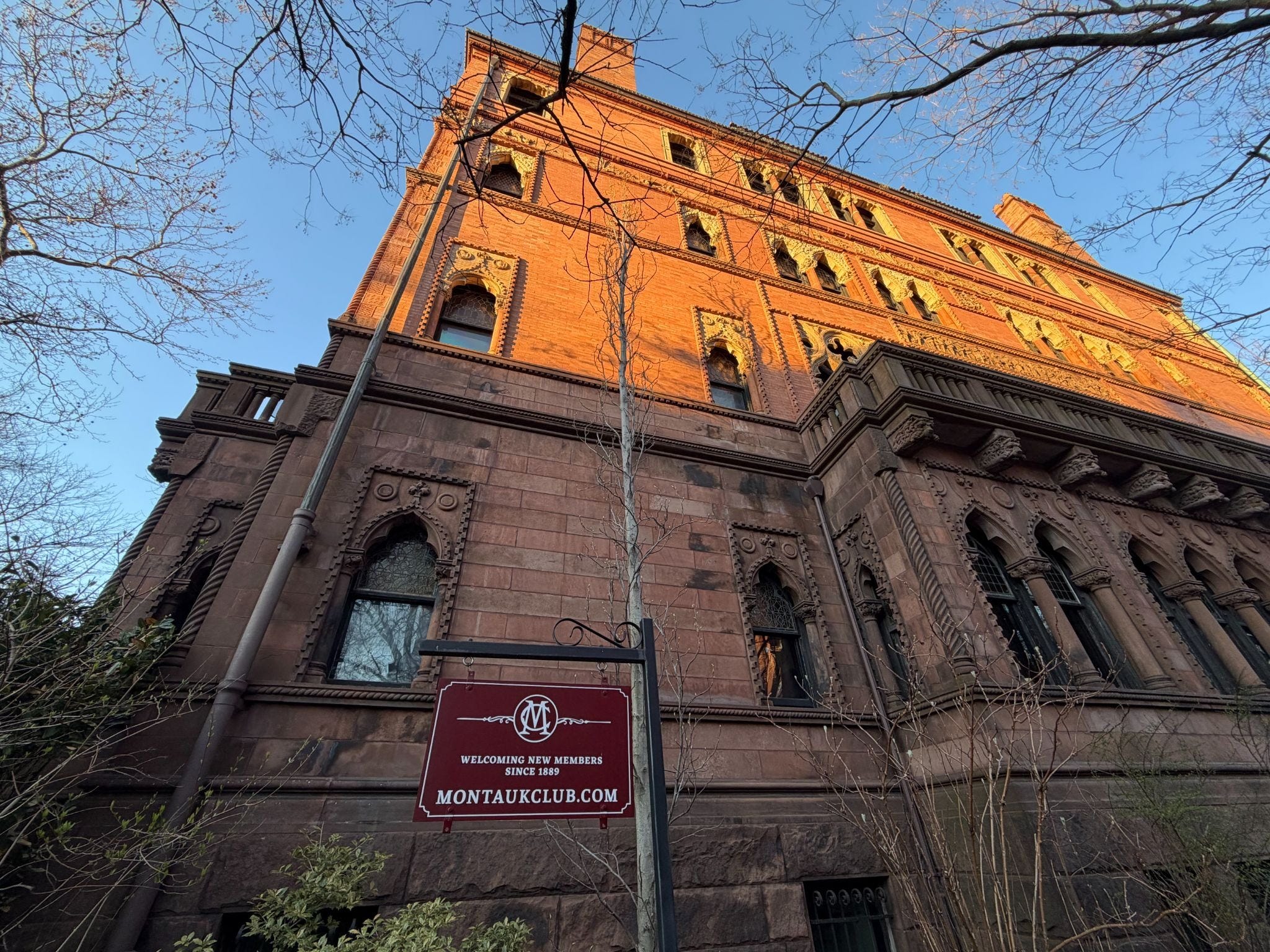
There were hundreds of private social clubs in Brooklyn during the Gilded Age. The Montauk Club, located in the heart of Park Slope, is the only surviving one.
How has the institution managed to stay relevant? I posed this question to its president, Mary Brennan. “I shouldn’t say this, but we probably have gone through periods when we weren’t terribly relevant,” she replied. “But I think we are relevant now.”
This month marked 135 years since the clubhouse was built. The pointed arches on the façade and the window’s Quatrefoil shape draw inspiration from the Ca’ d’Oro, a palace on the Grand Canal in Venice. The brick-and-brownstone building is adorned with verdigris copper, stained-glass windows, and terra-cotta friezes depicting scenes from the history of the Montaukett people of Long Island after whom the Club is named. (However, as noted on the Club’s website, the clubhouse is on the traditional lands of the Lenape.)
This month also marked five years since Brennan, then a member for almost three decades, became president. At the start of her tenure in 2021, she worried she might be the president under whom the Club would close. “COVID brought us to our knees,” which is unsurprising given its dining and drinking services, she said. “We were at risk of going bankrupt and wanted to see if we could turn it around.”
“COVID enabled us to switch gears,” she continued, “and abandon the attitude of ‘Well, that’s the way we’ve always done it’ or ‘That’s the way other clubs do it.’”
For example, there was a time during the pandemic when the Club could not afford linens, so it temporarily switched to paper, “which some of our more longstanding members were absolutely apoplectic about,” Brennan said. “Being flexible about things, and not rigid, is probably the single biggest change that we made.”
The Club also eliminated its dress code—just don’t wear anything offensive—and interview requirement. “We’re fairly informal and laidback,” Brennan said.
Essentially, membership is open to any applicant willing to pay the reasonably priced dues. In the past five years, the Club has rejected only two applicants: one from Florida who demanded a members’ directory, and a college underclassman seemingly hoping to drink underage.
Brennan added that the Club dedicated itself to being “as welcoming, open, and diverse as possible,” and continues to celebrate events from a range of cultures.
Unlike most of its erstwhile counterparts, the Club was relatively inclusive from its inception, welcoming both Democrats and Republicans, as well as Jews and Catholics—provided that they were white upper-class men, of course. Over time, however, the Club became a watering hole for “people of wit and good will.”
“I think it’s fair to say that virtually every other social club, certainly in New York City, picks its members because they fit a certain profile,” Brennan said. “We decided to go in a different direction. We’re not looking for a certain type—we’re looking for any type.”
As COVID-19 restrictions loosened, and bars and restaurants reopened, many people joined the Club because it felt safer than a crowded venue, with its drafty windows helping to improve ventilation. Before the pandemic, the Club had 220 members. During the pandemic, about 100 left. By the end of this past January, membership had grown to 625, an intergenerational community aged 22 to 92.
“The Club has not had that many members in probably 40 or 50 years,” Brennan said. “In an odd turn of events, COVID turned out to be very, very good for us.”
“We still worry about bankruptcy,” Vice President Dylan Yeats is fond of saying. “We just don’t think it’s going to happen this week.”
In 1955, lawyer and international diplomatic negotiator James B. Donovan joined the Club; over several rounds of gin rummy in the Card Room, he plotted the release of over 1,000 Bay of Pigs prisoners, along with nearly 9,000 Cuban political prisoners in 1962.
— Keep reading for more on the remarkable history made within these walls. —
